Jesus said, "And what I say to you, I say to all, Watch!” - Mark 13:37
THE FALSE PROPHET
POPE FRANCIS
WHAT DOES THE BIBLE SAY ABOUT THE FALSE PROPHET?
The Bible describes the False Prophet as a key end-time figure who works alongside the Antichrist, especially in passages like Revelation 13 and 19. He functions as a religious authority who promotes the Antichrist’s rule, persuading the world to worship him and establishing a global system of allegiance. Scripture says he performs deceptive signs and wonders, using supernatural displays to legitimize the Antichrist’s authority and mislead many.
In this framework, the False Prophet acts as the spiritual force that advances the Antichrist’s political and military power, directing devotion and loyalty toward him. The New Testament portrays these miracles as empowered by satanic influence, serving as a counterfeit parallel to God’s work—drawing people away from truth and toward rebellion rather than faith.
POPE FRANCIS RESURRECTION & The Prophetic Timeline To The 3rd Temple
YouTube
May 12, 2026
What if the timeline to the 3rd Temple has already been revealed in Scripture? In this video, we break down a prophetic timeline.
Don't Forget to order my book
6TH Millennium Series - 1st Chronicles
The Falling Away
A Book Authored By West "Watchman" Brooks
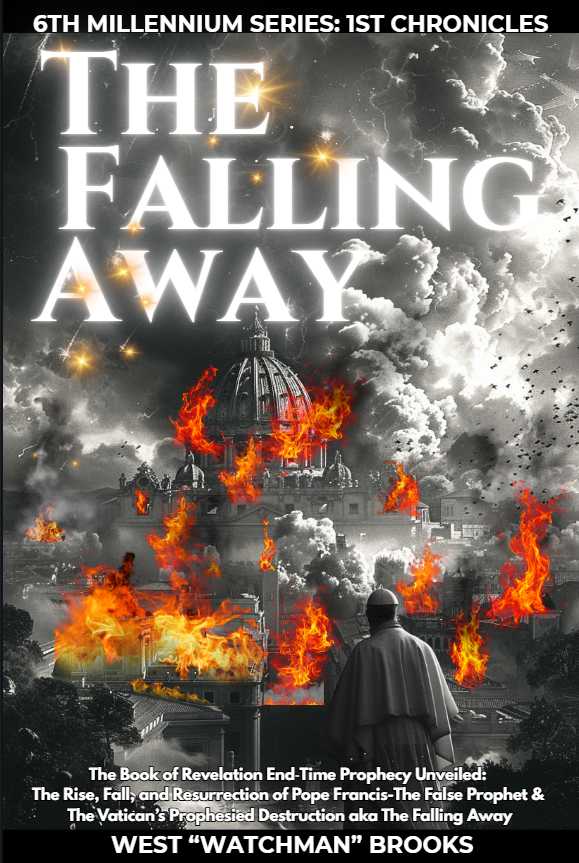

Here's what you get:
Deep Biblical Analysis
Clear explanations of Revelation that connect scripture with real world events.Historical Evidence & Timelines
Discover key events involving the Vatican, world leaders, and prophecy that most churches never discuss.Prophecy Charts & Visual Guides
Easy-to-understand diagrams showing how Revelation 17 may already be unfolding.A New Perspective on “The Falling Away”
Learn why the biblical “falling away” may refer to a prophetic event involving the Vatican.
Reviews
"Wow! This book is beyond informative, with proof in history events backed up with scripture. The way the author wrote this book is an easy read for any Bible prophesy beginner like me. It give the reader the opportunity to to do their own research without being misled. I truly enjoyed this book and I honestly I can't wait for the next book where he will explain who the Anti-Christ can be. It's a must read, study research and preach subject which most churches lack to address. I learn abundance with lots of note taking. I recommend this book 100x over n overall great book to add to your collection!"
"This book is the best book I’ve ever read that explains the book of revelation and connects the Bible to our current times. This book is set out in a logical sequence. The author should be highly praised for his outstanding and exceptional work. It shows his superb knowledge and wisdom in respect to this matter. I can’t wait for his next book to come out. It is definitely a must read."
"I've been studying eschatology and the various interpretations on the book of Revelation for years.
The interpretation of prophecy found in this book, is UNIQUE & extremely interesting. It's also very straightforward and simple to understand. One of the best interpretations I've come across in my studies. I recommend this book to all those who remain unconvinced with the mainstream interpretations. I give it 5 Stars."
PROPHETIC EVENTS TO WATCH FOR
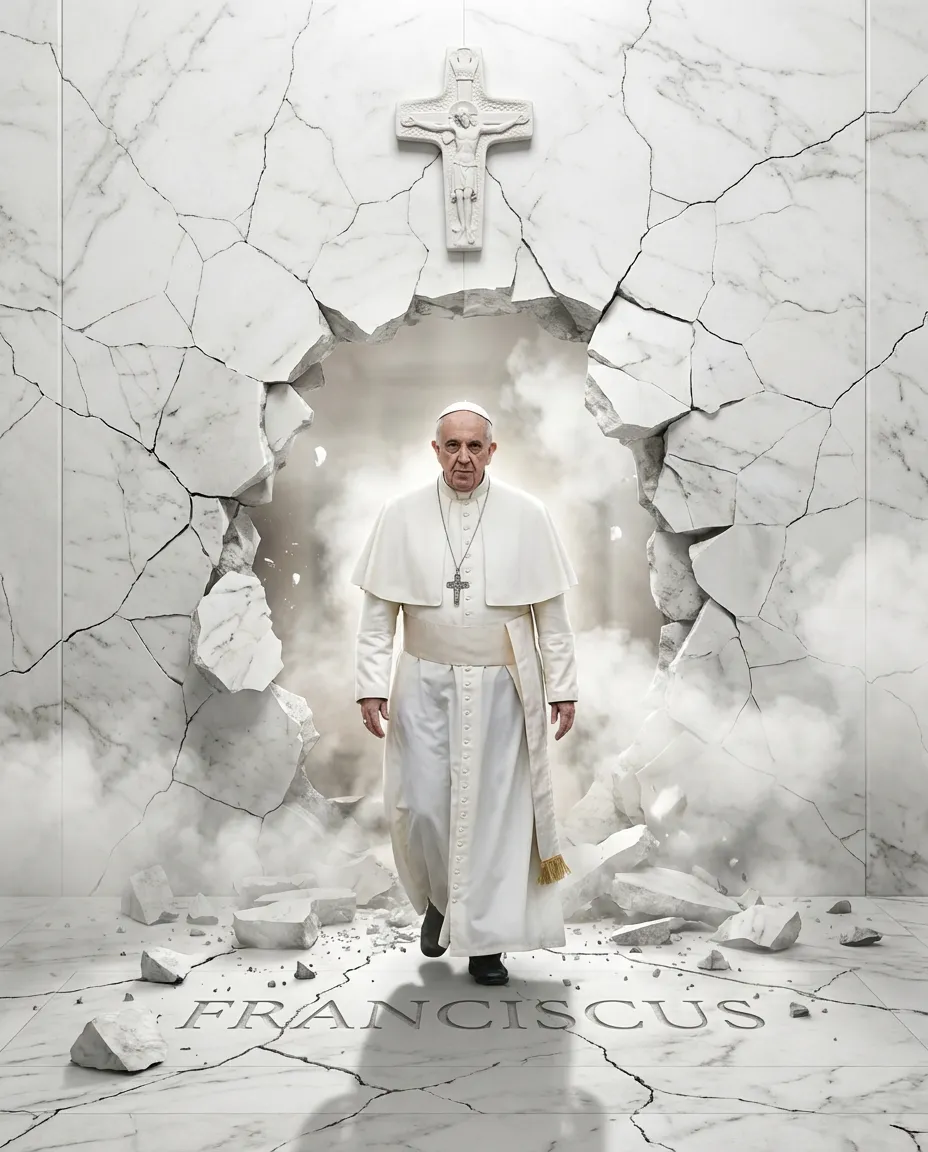
"The Beast Rises From The Bottomless Pit"
Jesus indicates in Matthew 24, the end times BEGINS with deception and a "Great delusion". What could be more deceiptive than the resurrection of a Pope revered by the world and accepted by Islamic Nations. Resurrection of Pope Francis, reference Revelation 17:8 " The beast that you saw was, and is not, and will ascend out of the bottomless pit and go to perdition. And those who dwell on the earth will marvel, whose names are not written in the Book of Life from the foundation of the world, when they see the beast that was, and is not, and yet is."
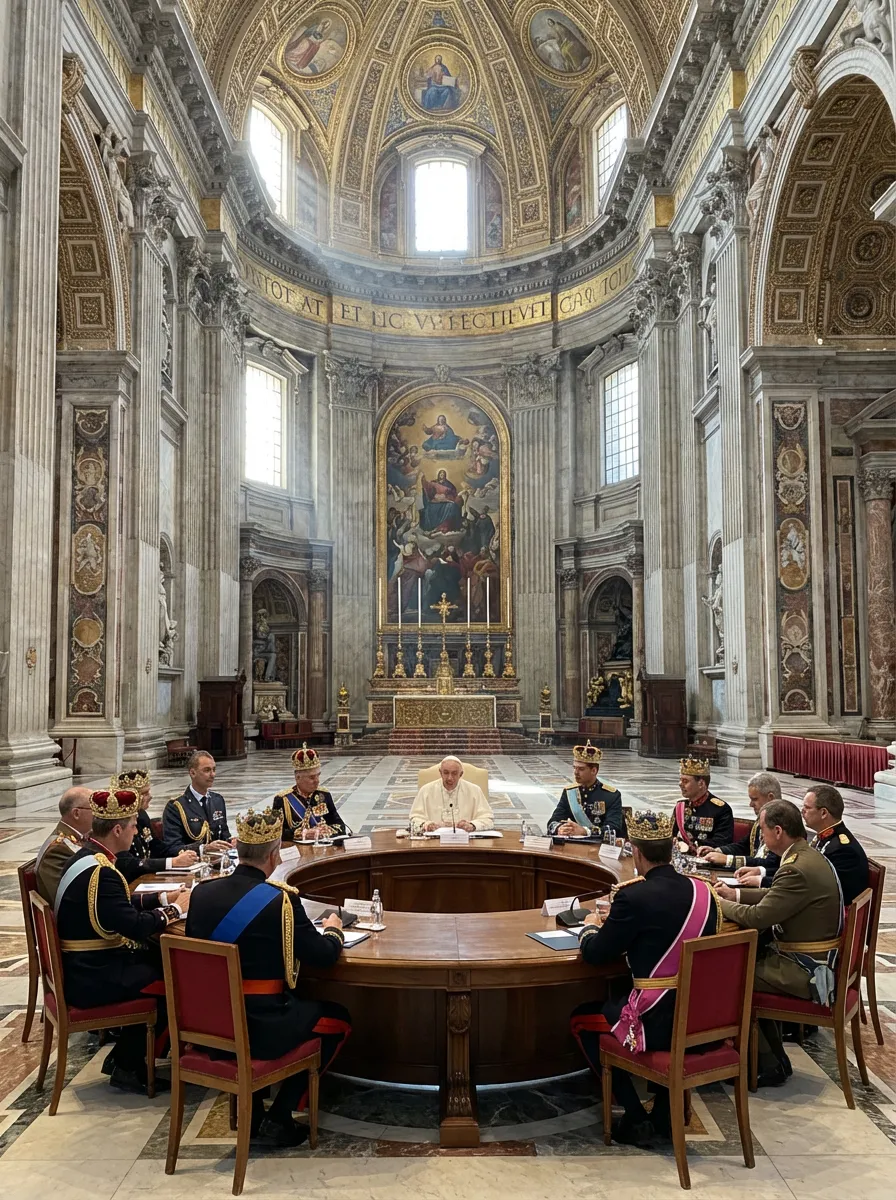
"10 Kings Receive Power & Authority WITH Pope Francis"
10 Kings of Europe receive power & authroity WITH The Beast, Pope Francis, reference Revelation 17:12 "The ten horns which you saw are ten kings who have received no kingdom as yet, but they receive authority for one hour as kings with the beast." The False Prophet
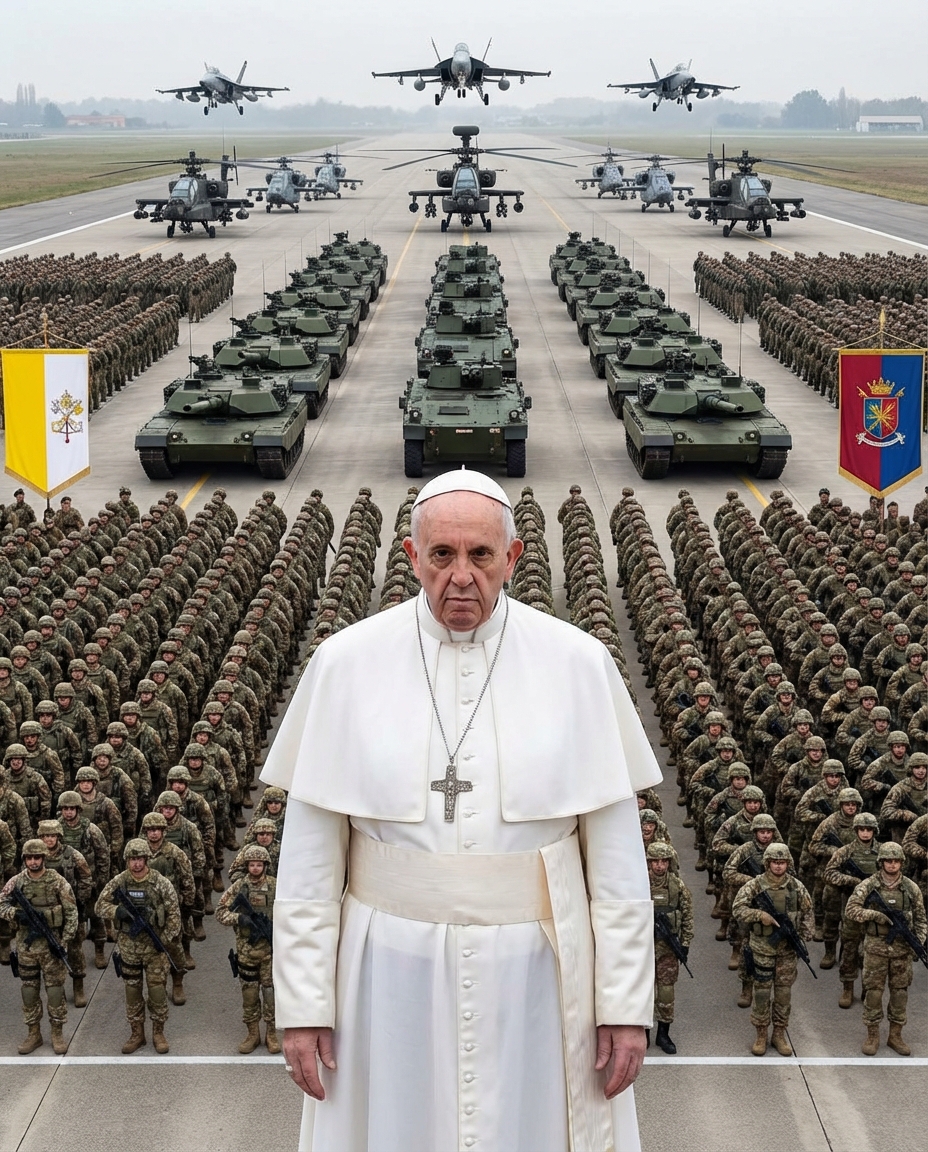
"10 Kings Give Their Power & Authority TO Pope Francis"
After God raises up Pope Francis and he receives the power of 10 Kings, God will use him to carry out judgment on the Vatican. Reference Revelation 17:16 "And the ten horns which you saw on the beast, these will hate the harlot, make her desolate and naked, eat her flesh and burn her with fire.
WATCH HOW revelation 17 IS unfolding as we speak
REVELATION 17:1-5 The Harlot Of The End Time
Revelation 17:1–5 describes a woman—“the great harlot”—sitting on a scarlet beast with seven heads and ten horns, clothed in purple and scarlet, adorned with gold, precious stones, and pearls, and holding a golden cup in her hand. Some interpreters see symbolic parallels between this imagery and the historical pageantry of the Roman Catholic Church. They point to the use of red and purple garments worn by cardinals and bishops, the gold and jeweled ornamentation historically associated with papal regalia (such as the papal tiara), and the use of a golden chalice in the Mass as visual similarities to the woman’s attire and golden cup.
REVELATION 17:6-7: The Harlot Drunk With The Blood Of The Saints
Revelation 17:6-7 describes the woman as “drunk with the blood of the saints.” Many historic Protestant interpreters connect this to persecution under the Roman Catholic Church, citing events like the Spanish Inquisition and the reign of Mary I of England, when Protestants were executed for rejecting papal authority. Others view the passage more broadly as symbolic of corrupt religious power.
REVELATION 17:8: The Resurrection Of The False Prophet
Revelation 17:8 describes a beast that “was, and is not, and will ascend out of the bottomless pit,” causing the world to marvel. Some interpret this as a future false prophet figure who appears to return from death, creating global deception. In that view, a resurrected leader identified by some as Pope Francis would mirror Christ’s death-and-life pattern, fulfilling Jesus’ warning that the end begins with powerful deception that captivates those not written in the Book of Life.
REVELATION 17:9 The Seven Mountains
Revelation 17:9 says, “The seven heads are seven mountains on which the woman sits.” Since the angel interprets the symbol directly, many see this as pointing to a literal location widely associated with Rome, known historically as the city of seven hills. In this view, the text identifies a physical setting rather than abstract kingdoms, though others interpret the mountains symbolically as ruling powers. It's unwise to doubt the interpretation of the angel giving the answer.
REVELATION 17:10 The Seven Horns Are Seven Kings-Five Have Fallen
If someone follows the interpretation that the “seven kings” of Revelation 17:10 represent a sequence of modern popes beginning in the early 20th century, the first five who “have fallen” (meaning they died) would commonly be listed as:
1. Pope Pius XI
2. Pope Pius XII
3. Pope John XXIII
4. Pope Paul VI
5. Pope John Paul I
In this framework, these five are considered the “fallen” because each has died, leaving the remaining two in the prophetic sequence.
REVELATION 17:10 One Is [The 6th]
In this interpretation of Revelation 17:10, after “five have fallen,” the phrase “one is” points to the 6th king in the sequence. Applied to the modern papal line beginning with Pius XI, the sixth would be Pope John Paul II. During his long reign (1978–2005), he was the one actively ruling—“the one who is” at that moment in the unfolding prophetic timeline.
1. Pope Pius XI
2. Pope Pius XII
3. Pope John XXIII
4. Pope Paul VI
5. Pope John Paul I
6. Pope John Paul I
REVELATION 17:11 The 7th Will Be There A Short Time
In this view of Revelation 17:10, “the other has not yet come; and when he comes, he must remain a short time” points to the seventh pope in the sequence. This is interpreted as fulfilled in Pope Benedict XVI, whose pontificate (2005–2013) was unusually brief. His historic resignation in February 2013 marked a rare and short tenure, aligning with the phrase “continue a short time.”
REVELATION 17:12 The 8th Is The Beast
Some interpret Revelation 17:11—“the beast…is himself also the eighth”—as pointing to the pope who followed Benedict XVI. In this view, Pope Francis, elected in March 2013, is seen as the “eighth” arising from the previous seven. Interpreters who hold this position identify him as the “beast of the sea” and the “false prophet,” a final religious leader in their end-times framework.
REVELATION 17:12 The Resurrection Of Pope Francis aka The False Prophet
Revelation 17:8,11 repeats “was, and is not, and yet is,” which some see as a heavenly title “the resurrected one.” In this belief framework, the death of Pope Francis in April 2025 sets the stage for a future return, marking him as a candidate for the beast who ascends. Such a resurrection would be the prophetic turning point that launches the final events of Revelation.
Jesus said, "And what I say to you, I say to all: Watch!” - Mark 13:37
The False Prophet Playlist
Will Pope Francis Resurrect? The Shocking Prophecy Hidden In Scripture
The Watchman Has Returned: Why I Can't Stay Silent
Pope Francis (Who Was, And Is Not, Is ) Laid To Rest & Suspending The Revelation Watchman
Revelation’s Scarlet Woman Revealed | The Harlot, the Beast, and the Roman Connection
10 Kings, 2 Regions, 1 Prophecy | Europe & the Middle East in Daniel and Revelation
The 10 Kings, the Beast, and the Harlot | Revelation 17 Decoded
The Daniel Prophecy Pattern EXPOSED | Why the Middle East & Europe Matter Most
The Timeline of Mankind Decoded | Daniel’s Statue Reveals Where We Are Today
Daniel’s Statue Revealed: The Timeline of Mankind and the Return of Jesus
Could These Two Men Be the Antichrist and False Prophet? | Bible Prophecy Watch
Bible Prophecy Is a Puzzle | Understanding the Antichrist, False Prophet & UFO Connection
What Is Bible Prophecy? | The True Purpose Revealed for the Church
Welcome to the Revelation Watchmen | Bible Prophecy You Need to Know NOW
Is Pope Francis Destined for a Supernatural Encounter? A Shocking Biblical Pattern!
Exploring the 3 Outcomes: Pope Francis's Health as the False Prophet
Prophecy Alert: Pope Francis and the Rise of the Ten Kings (Revelation 17 Explained)
Pope Francis - The Rise of the False Prophet In The Book Of Revelation
The Prophetic Rise of Ten Kings and Pope Francis: A Watchman's Perspective
THE FALLING AWAY - I'm EXPOSING the Last Days Prophecies About Pope Francis
The "Falling Away": Unveiling Prophecies of the Last Days & Pope Francis
The Significance of Pope Francis as the False Prophet in Prophecy
Unveiling the Interconnected Prophecies: Pope Francis, Princess Ben, and the UFO Abduction Phenomeno
Is Pope Francis the False Prophet? Meeting with Indonesian President to Discuss World Peace!
Does Pope Francis Want To Redefine What It Means To Be Human?
Pope Francis Speaks Out: Civilians Targeted in Gaza—Is He the Key to Global Peace?
Pope Francis to visit Israel, Jordan & Antichrist Prince Hassan Bin Talal
Pope Francis & The Coming UFO/Alien Deception
Must See!!! How Pope Francis & Catholic Church Fulfill Book of Revelation Prophecy
Revelation Prophecy: Pope Francis Will Destroy The Vatican With The Power Of 10 Kings
Who Is the Antichrist in the Bible? The Revelation & Rise Of Prince Hassan Bin Talal of Jordan
Israel's WAR with Hamas in Gaza & What BIBLE PROPHECY we should look for?
Who Is the Antichrist in the Bible? The Revelation & Rise Of Prince Hassan Bin Talal of Jordan
Subscribe For The Latest Videos
Stay up-to-date with all our latest episodes, exclusive updates, and deep dives into the world of bible prophecy. Subscribe now and get notified whenever new content drops—right at your fingertips!
Newsletter

The Revelation Watchman
Support
CUSTOMER CARE
LEGAL
FOLLOW US


Copyright 2026 NDUR Watchman LLC. All Rights Reserved.